Welcome to The Amphibious Warfare blog, the place for you who can't decide whether you prefer mud to salty seas or vice versa. Here you'll find books, films, model kits and a few other things that are related to the world of amphibious warfare, many times from a modellers point of view. Do not hesitate to comment or give me a hint if you miss something here. Please do not expect this blog to get updated every day.

/Stellan
Showing posts with label GMC. Show all posts

25.5.12

A Photo: GMC in North Africa 1942 (edited)


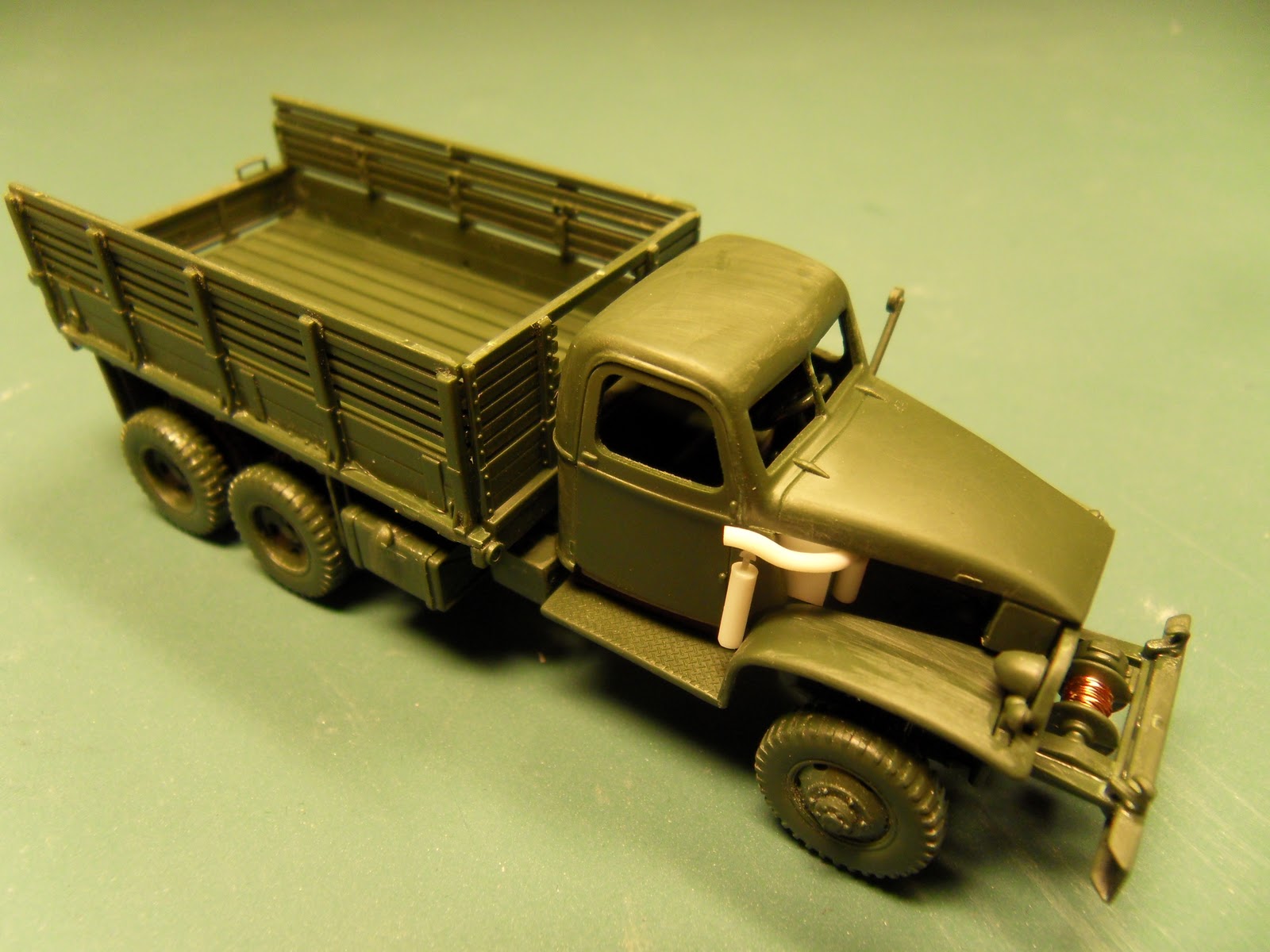
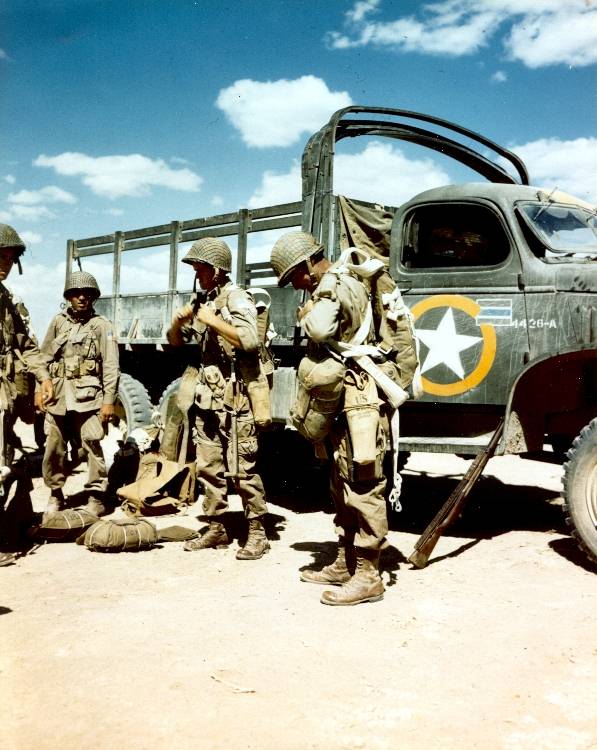
As I'm putting all together for my Operation Torch LCM 3, I thought an original photo of a GMC truck could be nice to see. The photo is showing some american soldiers of the 82 Airborne preparing for a jump in North Africa, late 1942. The only visible structural difference from my Academy truck is the omission of an engine vent tube on the right hand side. Source: United States Army via WW2 Database.

Ed. Found this photo on the cover of US Special Forces of WW 2, published by Arms and armour press. The caption says photo is of paratroopers of the 82nd Airborne preparing themselves to jump at Salerno in September 1943. Our friend Google found some answer for us and it seems like this latter caption is right. 82nd did jump on Salerno from bases on Sicily, and Steven Zaloga's Osprey Vanguard No 39 says the yellow circle marking was common on Sicily. Or does some of you have any other explanation...? But it is easy to see why someone would believe that the photo was taken in North Africa as the yellow circle was also added to the insignia on American aircrafts during the Torch landings in 1942.

23.5.12

On the bench; LCM 3, Operation Torch 1942, part 8


I thought I was too tired to work on my Torch project tonight but I did well anyway. Put a coat of Vallejo olive drab all over the truck, inside and out. After that I picked all bags out in different shades of olive greens. Added a bit of tan and yellow sand as I went in order to break up the load's uniformity.


Of course I had to test the truck in the cargo hold to see how the colours went with the landing craft's white and dark grey. Just perfect! Now all is about wrapping the whole thing up. In this photo you can see the little handles I made yesterday.

22.5.12

On the bench; LCM 3, Operation Torch 1942, part 7


OK fellows, the load has dried and a few sacks got a tiny handle of paper although it can't be seen here. The US flag is printed on ordinary paper and will be attached to the right hand side window as a 'Don't shoot, we're the nice guys!' kind of mark. On the hood I'll put a white star on a dark blue background, I found a decal of the right size. Before I can paint the lot I'll have to paint the inside of the driver's compartment, add windows and a piece of canvas over the front grille. Now, where on earth are the little fire extinguisher i scratched before...

15.5.12

On the bench; LCM 3, Operation Torch 1942, part 6


Loaded my GMC truck tonight. Lots of small sacks are the reason for the 6x6 to hitch a ride to the beach. Rolled a long fat string of Milliput and made about 50 sacks. In order not to make a too heavy load I lined the insides of the cargo hold with Milliput and put a lid of plasticard before covering the whole lot with my little sacks. I'll let this dry a day or so and then start next painting session. Pressed the end of a brush handle to sculpt each end of the sacks to make them stand out a bit more. A bit of water was taking the finger prints away as Milliput tends to show such blemishes quite well.

24.1.12

On the bench; LCM 3, Operation Torch 1942, part 1

Since mid December 2011 I have been working on an LCM 3 project. It is Trumpeter's little boat in 1/72 that's getting some extra attention. It will be loaded with an early GMC 2 ½ truck in its hold. I saw a photo in a book showing a truck being off loaded from an LCM 3 during Operation Torch in North Africa and felt this was something for me to make a model of.

The truck from Academy got a bit of extra details added as per the photo; some tube on the side coming out of the hood, a fire extinguisher and some copper wire to add some sense of detail on the winch.

A bit of extra work has to be done to make it into a Royal Navy LCM. Anti-splinter padding on the wheel-house, an anchor windlass, special ramp wire holders sticking up like horns on a rein deer.


The skegs got some extra attention. Supporting struts were glued to each side as you can see here. As far as I know the propellers should have only three blades each, not four as in the Trumpeter kit. Do I care? Nah.


And the wire holders in the front. 

23.1.12

A book; DUKW In action


DUKW In action, Timothy J Kutta, Squadron/Signal publications

Most modellers have previous experience from the Squadron/Signal line of publications. Not everything to know but quite a lot is what you will find in this; history, development, who, what, where, when etc. If you just want to know a bit extra about the model ju intend to build this is the book for you.