Welcome to The Amphibious Warfare blog, the place for you who can't decide whether you prefer mud to salty seas or vice versa. Here you'll find books, films, model kits and a few other things that are related to the world of amphibious warfare, many times from a modellers point of view. Do not hesitate to comment or give me a hint if you miss something here. Please do not expect this blog to get updated every day.
Tank Warfare on Iwo Jima, David E Harper, Squadron Signal, 2008
96 fact packed pages of colour side views, photos and text helps the model builder to recreate one of the most famous tanks ever, the M4 Sherman, from one of the most famous battlegrounds ever, the one on Iwo Jima in 1945. If you have seen the films Flags of our fathers and Letters from Iwo Jima you know a bit what the fighting was like but can never fully comprehend what the soldiers went through. The photos of war weary tankers, blown up Shermans and the conditions of the fighting are mildly said sobering. If you like the Sherman this book is a must. Lots of colour and markings, not just Olive Drab and white stars like in the ETO.
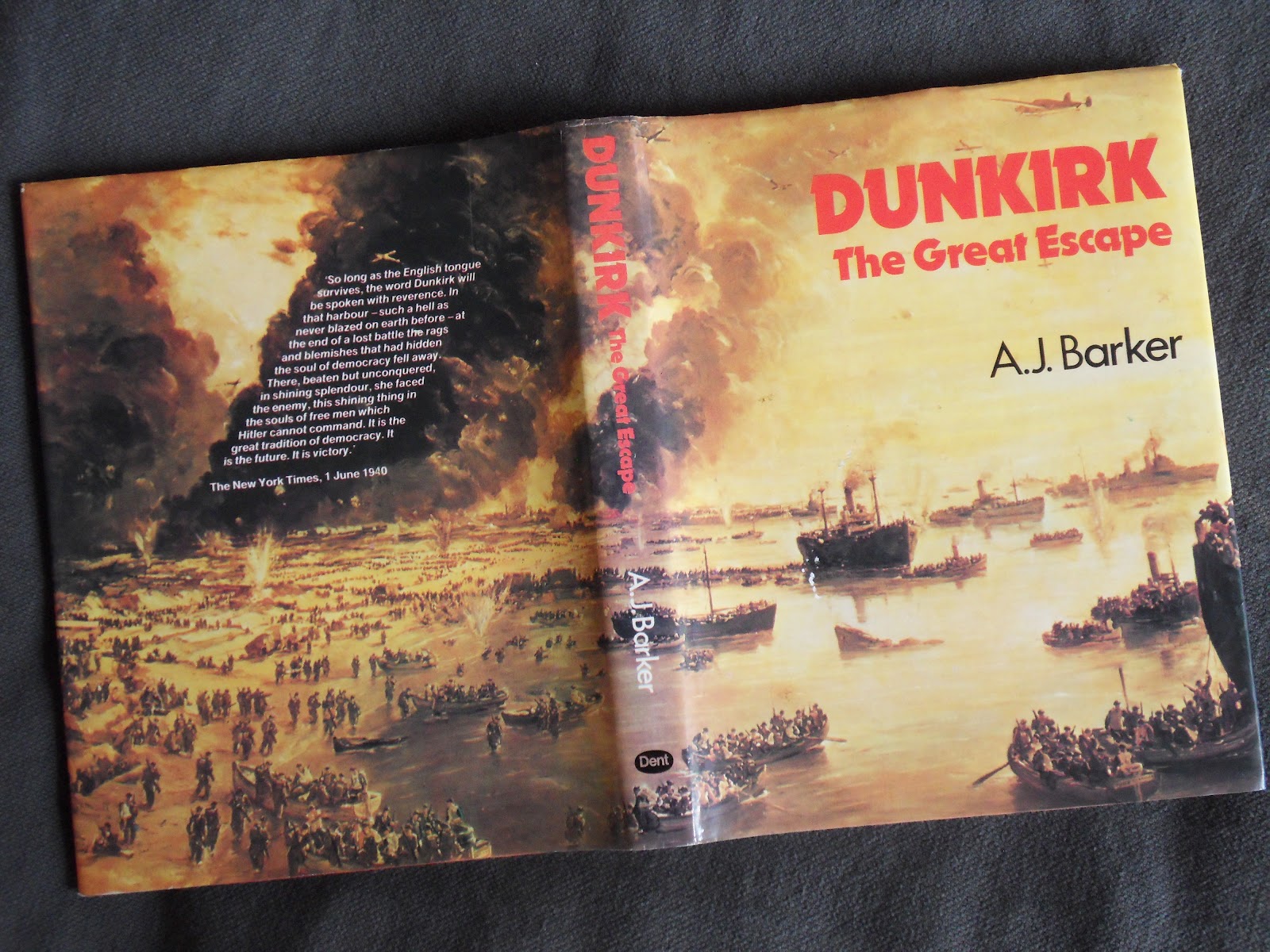
Dunkirk, The great escape; A.J. Barker, J.M. Dent and Sons Ltd.
Is an evacuation regarded as amphibious warfare? Yes, in my book (as a matter of speaking) it is. In 1940 the BEF, British Expeditionary Force, fought alongside the Belgian, Dutch and French in order to halt the German advance. The swift maneuvers and heavy fire power of the Germans were not possible to stop but the defenders were gradually wiped out or forced back. When the final outcome was clear to the British an order was issued to evacuate the remaining forces. It was understood that at some point it was useless to pour in more soldiers and fighers just to have them slaughtered and shot down, it was better to save the men and aeroplanes to fight another day, so plans were made up to pull back slowly and in order. The beaches and harbours were filled up by retreating soldiers in Dunkirk. Vehicles massed up and were set a blaze to hinder the Germans from using them after the inevitable end. Hundreds of vessels, small civilian, trawlers, destroyers, tugs and so on went from the French coast to the English to save what could be saved of an army. From 26 May to 4 June 1940 soldiers endured artillery shelling and aerial bombarment on the beaches and on the ships. When the evacuation was over more than 300 000 soldiers were saved to British soil. The survivors were battle hardened and experienced now and formed a foundation to build up new forces to keep the fighting going. This is however another story.
Many times journalism is made with a telephone by a desk in a town. War journalism can not be made that way but has to be done where the action is. One such reporter who went where it all happened is Max Hastings and he was at the Falkland Islands during the conflict in 1982. Going to the Wars is a compilation of some of the conflicts Hastings has covered, like a comment of the years spent at the front lines. Northern Ireland, Vietnam, Angola, Biafra, Yom Kippour, Rhodesia are there as the chapters on the Falklands. A good quarter of the book is on the South Atlantic events and is a jolly good reason for reading it. Max Hastings is also the author of Overlord and The Battle for the Falklands, two other books on amphibious matters. Will have to check them out I guess.
I guess many people have what to call their "own" war, the ones that made a visual and historical impact on them. One of mine is the Falkland conflict that ended 30 years ago, on this day. Of course, I did not participate in it but just like the first Gulf war this one was real, it happened right there and then, it wasn't just old history from way back.
I will not get into the politics or the history of the conflict, you can read about it on the internet and in books and make up your own mind about it. The Wikipedia article on the topic seems to be extensive although I can not say for sure if there are any omissions, faults or the like. Wikipedia also have a couple of extensive articles on the British naval forces as well as the Argentine naval forces in the conflict.
Well, what amph models are there if one wants to have a piece of Falkland history? In my collection I haven't got much from the conflict but Airfix' HMS Fearless in 1/600 can be found, as can Hobby Boss' LVTP-7 in 1/35. So at least I have one model from each nation directly involved in the war.
The Fearless model is a bit basic and heavy but can be fixed with some TLC. Check out this one that Andy Mullen did, or Frank Spahr's. There are a few small landing crafts included in the kit just screaming to be painted in tiger stripes just as they were in 1982, and Frank did that! Typical camouflage painting can be seen here. Some one should make a British LCVP in 1/72 or 1/35 and a box full of Royal Marines to go with it! Or are there already one out there...?
Two LCUs and four LCVPs are included in the box.
The Hobby Boss LVTP-7 is complete from head to toe, no more scratching if you want an interior for your Tuna Boat. Missing Lynx has a nice review on the Hobby Boss AVVP7-A1. Basically it should be the same model as the LVTP-7 but with some exrta details to bring it up to AVVP7-A1 standard. The Osprey New Vanguard #30 on Amtracs has a colour profile and a short explaining text to it, this profile can also be found at the Malvinas Online site together with some nice photos of the real vehicles. The Hobby Boss kit have small anchor and flag decals one should be able to use, the vehicle number should be found in the decal spares box or masked and airbrushed on. Add a bit of dark green paint and you're done (I think...).
I haven't compared the Hobby Boss and Academy LVTP-7 kits but I guess it should be possible to use the latter as well.
In this footage from the invasion one can spot some small landing crafts of the Argentine Navy, looking like good old LCVP of Higgins type. Anyone having any information on them, like colours and markings? A few sequences also confirms the very few markings the LVTPs had. A blurry sequence shows some LARC-V from the ARA Cabo San Antonio driving up the beach. After having seen this film we may add LCVP, LARC-V and LST to the list of things to model from the conflict. Also in use during the conflict were the Centurion BARVs brought to shore by the LCUs attached to the HMS Fearless and her sistership, HMS Intrepid. Check out this
restored one, it's by the way same as at the Centurion BARV page. At
the Model Shipwrights page you may find a nice semi-scrached model,
click here and here.
A biography? Yup. Any machines? Yes, a bit. If you ever heard of Hobarts Funnies and hoped for it to be a travelling burlesque show or so may have your dreams shattered. This is the biography on the man who created and commanded the armoured division breaking through walls and bunkers using Churchill AVREs, bobbing ashore in Sherman DDs, chain-wipping the beaches in order to clear them from mines etc. Major General Sir Percy Hobart took charge and developed the machines that the allied forces used to breach the Atlantic wall and made it possible to push on, cross the Rhine and ultimately crush Nazi Germany. As this is a biography the dedicated amph head might get a bit disappointed as there are not enough photos or stories on the specific machines we all like. Still, Hobart was a very important individual during the WW2 and this is the story about his experiences and visions. This guy was bloody important for the final victory, I'd say.
VW im Kriege, Kübelwagen, Sonderkonstruktionen, Schwimmwagen; Michael Sawodny, Podzun Pallas Verlag
50 pages of good clear photos and technical drawings from field tests and front line duty makes this book (or booklet if you prefer) a fine source if you want to understand the development and use. The VW base made the Kübelwagen and Schwimmwagen two of the most simple and versatile vehicles in use during WW 2. Why is it that these two German vehicles have been generally overlooked by model makers and modellers alike? Too boring, not enough guns, not speculative enough? Speaking of German,well the text is entirely in German but that is not a big problem as the short texts are quite easily understood and the photos says it all anyway.
Commandos from the Sea; John B Dwyer, Paladin Press
'The first amphibious operation in US military history occurred in March 1776...' this book begins and the rest is history, as they say. This is an eye witness account of the build up, training and operational roles of the US amphibious commandos. Ever heard of the Scouts & Raiders, Naval Combat Demolition units, Underwater Demolition Teams, Unit Robby, Phib Recon Marines or Beach Jumpers? Of the units mentioned, only UDTs were known to me. This book is in a big size and not many photos are included so there is the more to read and learn from.
The Wold Encyclopedia of Amphibious Warfare Vessels; by Bernard Ireland, Lorenz Books
I have been searching high and low for quite some time for an encyclopedia containing and comparing most, if not all, amphibious vessels. Now, i got it! The first 90 pages are texts on amphibious landings of different kinds and tactics, planning, logistics etc. The following 150 pages are dedicated to ships, various landing crafts and air cushion vehicles. Almost every type is getting one or two pages each for history, use and development. If you thought LCMs and LSTs were the only vessels for amphibious operations, please rethink! The book concentrate on the large countries capabilities but misses out totally on smaller crafts from smaller countries like the Swedish CB 90, now in use in half a dozen countries. The US Navy and Royal Marines have or are planning for including this nimble little boat in their inventories. A Norwegian CB 90 is on one of the opening pages in this book so it's only half an omission! Read more about Combat Boat 90 here.
A smashing little publication on the British Commandos in action. Weapons, training, equipment, battle dress, transportation and so on is covered. All operations including commandos are accounted for. I especially appreciate the Vågsö, St Nazaire and Madagascar chapters as they are not too well known. This is a thin but well packed publication on the hardest of hard men. Few things symbolize true amphibious operations as well as the commandos.
Yes, it´s been a while now since last time. Not much time to spare and a final push to have something to show at the Modellexpo 08 Open in Stockholm last weekend took all my effort. I searched the tables for some amphibious related models but the only one was my LCVP from Pegasus. What a shame! This has to be changed from now on, I have to get on with my mission of letting the world be aware of all things amphibious. If you're curious about the model show you'll find the class winners here.
Now, what did I find on the show then. Well, there was a couple of books on Dunkirk, a sure must have as an amphibious freak.
DUNKIRK, The Great Escape by AJ Barker...
...and the comic novel Dunkerque by Pierre Dupios. The first is in English and the second is in Swedish. I'll get back to theese two a bit later.
Three of Osprey's books on amphibious matters found their way into my shopping bag; The Rhine crossings 1945, Anzio 1944 and US WW2 Amphibious tactics. Great reading this spring.
And last but not least, a T-37A from Ukrainian firm Fort /LF Models. This is a model kit I've never heard of before and a pleasant surprise.
The D-Day Companion, edited by Jane Penrose, Osprey Publications
For a broad understanding of one of history's most important events The D-Day Companion is possibly the best bet. In thirteen essays all facets of the planning, execution and aftermath of the biggest combined operations event of all times are probed and dissected. You will not find many individual stories here. Emphasis is on the wide perspectives although a few personal accounts show the feelings and confusion from both attacker as well as defender. It's just a three days read and thus a perfect companion for the student or war gamer wishing to get an introduction to the Normandy landings and associated actions.
WW II US Landing Craft in action, Al Adcock, Squadron/Signal publications
A fair introduction to the landing crafts and landing ships in US Navy use but do not expect to get fully educated or enlighted after having read this. The title says it all: hardly a word on British or French use of the oh so common materiel of an amphibious assault force. A supplement to other published matters but not really the one and only publication to lean on if you want to know more on this topic. What I do like is the number of line drawings and many photos of crafts and ships in action. The centre fold is great as it is showing three of the larger types in tropical camouflage schemes plus a number of the smaller ones.